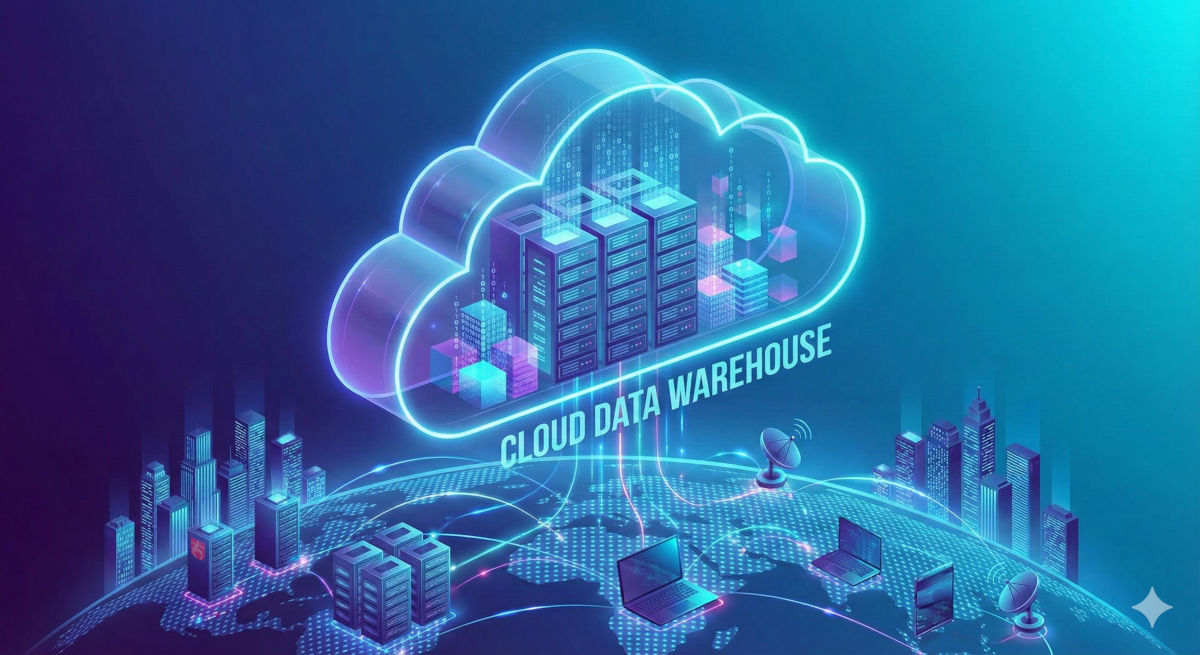
Introduction
The rapid expansion of cloud computing has sparked debate over whether data warehousing is becoming obsolete. While cloud-based data platforms have transformed how organisations store and process data, this shift does not eliminate the need for data warehousing. Instead, it represents a significant evolution in how data warehouses are designed and deployed. Data warehousing remains a fundamental component of modern analytics, providing structure, governance, and reliability that cloud storage alone cannot deliver (Inmon, 2005; Kimball and Ross, 2013).
The Continued Need for Data Warehousing
Cloud platforms generate vast quantities of raw data from transactional systems, applications, APIs, and streaming sources such as IoT devices. However, this data is not analysis-ready by default. Data warehousing continues to play a critical role by cleaning, integrating, standardising, and optimising data for analytical use (Amazon Web Services, 2023).
Organisations still require a centralised “single source of truth” to ensure consistent KPIs, accurate historical analysis, regulatory reporting, and executive decision-making. Without a data warehouse layer, metrics may conflict, and reports may become unreliable, leading to poor business decisions (Kimball and Ross, 2013). Cloud storage alone does not address these challenges (Google Cloud, 2024).
From Traditional to Cloud-Native Data Warehousing
The idea of obsolescence largely stems from the decline of traditional on-premises data warehouses rather than the disappearance of data warehousing itself. On-premises systems are often limited by fixed hardware, high capital expenditure, and slow scalability (Gartner, 2023).
Modern cloud data warehouses such as Snowflake, Google BigQuery, Amazon Redshift, and Azure Synapse Analytics retain the core principles of data warehousing while addressing these limitations. These platforms provide elastic scalability, pay-as-you-go pricing, and integration with BI and machine learning tools, making them better suited to modern data demands (Snowflake Inc., 2024; Microsoft, 2024).
This shift demonstrates that data warehousing has not become obsolete but has instead transitioned to a more efficient cloud-native model (Gartner, 2023).
Modern Data Architectures Strengthen Warehousing
Cloud computing has enabled new data architectures that complement and extend data warehousing rather than replace it. Data lakes provide low-cost storage for raw and unstructured data but lack the governance and performance required for enterprise reporting (Databricks, 2024).
As a result, organisations increasingly adopt hybrid architectures that combine data lakes with data warehouses. The emerging lakehouse architecture merges the scalability of data lakes with the structured, governed analytics of data warehouses, reinforcing the continued relevance of warehousing principles (Databricks, 2024; Snowflake Inc., 2024).
Growing Demand for Data Warehousing
Demand for data warehousing continues to grow due to several factors, including the rise of cloud-based applications, the widespread use of BI tools like Microsoft Power BI, and the increasing importance of AI and machine learning. These advanced analytics workloads depend heavily on clean, historical, and well-structured data, which data warehouses are designed to provide (Vassiliadis and Simitsis, 2009).
Additionally, regulatory compliance, auditing, and data governance requirements further reinforce the need for structured and controlled data environments, particularly in sectors such as finance, healthcare, and government (Gartner, 2023).
Challenges and the Hybrid Reality
Despite its advantages, cloud data warehousing presents challenges, including cost management, governance, and security. Poorly optimised cloud usage can lead to unexpected costs, while rapid data ingestion can result in poorly governed data environments if not properly managed (Amazon Web Services, 2023).
Consequently, many organisations adopt hybrid or multi-cloud strategies, retaining some on-premises systems for sensitive workloads while leveraging cloud warehouses for scalability and advanced analytics. This hybrid reality further illustrates adaptation rather than obsolescence (Microsoft, 2024).
Future Outlook
Data warehousing is unlikely to be replaced entirely. Instead, it will continue to evolve through changes such as ETL shifting toward ELT, batch processing moving toward near real-time analytics, and rigid schemas being replaced by more flexible schema-on-read approaches (Vassiliadis and Simitsis, 2009; Google Cloud, 2024).
Despite these technological changes, the core purpose of data warehousing, which is to provide a trusted, centralised, analytics-ready data environment, remains essential (Inmon, 2005).
Conclusion
Cloud-based data does not render data warehousing obsolete. Rather, it modernises and strengthens it. While traditional on-premises warehouses may decline, cloud-native data warehouses and hybrid architectures represent the future of enterprise analytics. Data warehousing remains central to business intelligence, governance, compliance, and strategic decision-making in the cloud era (Gartner, 2023; Snowflake Inc., 2024).
References
- Amazon Web Services (2023) What is a data warehouse? Available at: https://aws.amazon.com/data-warehouse/
- Chen, M., Mao, S. and Liu, Y. (2014) ‘Big data: A survey’, Mobile Networks and Applications, 19(2), pp. 171–209. https://doi.org/10.1007/s11036-013-0489-0
- Databricks (2024) What is a data lakehouse? Available at: https://www.databricks.com/glossary/data-lakehouse
- Gartner (2023) Magic Quadrant for Cloud Database Management Systems. Stamford, CT: Gartner Research.
- Google Cloud (2024) BigQuery documentation: Introduction to data warehousing. Available at: https://cloud.google.com/bigquery/docs/introduction
- Inmon, W.H. (2005) Building the Data Warehouse. 4th edn. Indianapolis: Wiley Publishing.
- Kimball, R. and Ross, M. (2013) The Data Warehouse Toolkit: The Definitive Guide to Dimensional Modeling. 3rd edn. Hoboken: John Wiley & Sons.
- Microsoft (2024) What is Azure Synapse Analytics? Available at: https://learn.microsoft.com/en-us/azure/synapse-analytics/overview-what-is
- Snowflake Inc. (2024) What is a cloud data warehouse? Available at: https://www.snowflake.com/guides/cloud-data-warehouse
- Vassiliadis, P. and Simitsis, A. (2009) ‘Near real-time ETL’, Proceedings of the VLDB Endowment, 2(1), pp. 137–148. https://www.cs.uoi.gr/~pvassil/downloads/ETL/SHORT_DESCR/09AoIS_NearRealTime.pdf