
In the global banking sector, speed is both a primary asset and a significant vulnerability. As instant payment schemes such as the UK’s Faster Payments Service become the standard, capital can move across borders in milliseconds. While this provides unparalleled convenience for consumers, it also grants fraudsters a dangerously narrow window to exploit.
To counter this, financial institutions have moved away from traditional, rule-based security systems. In their place is a new generation of real-time AI, an autonomous defence layer that stops unauthorised transactions before a single penny leaves an account.
The Problem with Traditional Rules
For decades, bank security relied on static "if-then" logic. A common example would be a rule that flags any transaction exceeding £5,000 occurring in a foreign country for manual review.
While logical, these rigid rules are easily bypassed by sophisticated criminal syndicates. They frequently lead to "false positives," where legitimate customers find their cards blocked while travelling, or "false negatives," where clever, low-value fraud patterns go undetected because they fall just below the set threshold.
How AI Detects the Invisible
Modern AI does not wait for a rule to be broken. Instead, it uses behavioural biometrics and pattern recognition to build a unique "Persona Profile" for every customer. The system learns several key metrics:
- Typical Spending Habits: The specific times of day a customer usually shops.
- Device Metadata: The specific handsets or laptops normally used for banking.
- Interaction Patterns: The speed at which a user typically types their password or navigates a mobile app.
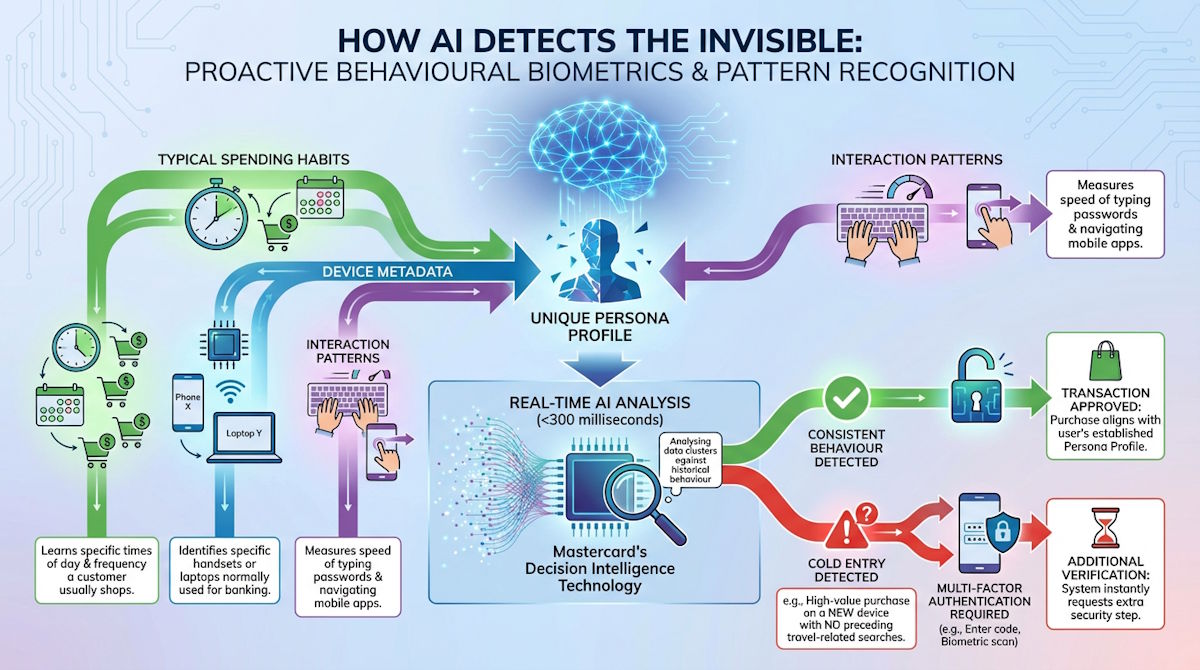
When a transaction is initiated, the AI analyses thousands of data points in less than 300 milliseconds. For instance, Mastercard’s "Decision Intelligence" technology uses these data clusters to determine if a purchase is consistent with a user’s historical behaviour. If the system detects a "Cold Entry," such as a high-value purchase on a new device with no preceding travel-related searches, it can instantly request multi-factor authentication.
From Detection to Agentic Prevention
The latest evolution in financial security is the implementation of Agentic AI. Rather than merely flagging an alert for a human analyst to review hours later, these autonomous agents can take immediate action.
They may automatically contact a customer via an AI-verified voice line to confirm intent or use Graph Neural Networks to see if a recipient's account is linked to known money-laundering rings. This adaptive learning allows the system to update its own detection logic as new fraud tactics emerge, without requiring a programmer to manually intervene.
Balancing Security and Seamlessness
The ultimate goal of AI in finance is "Zero Friction." Banks aim to protect every transaction while only inconveniencing a tiny fraction of legitimate customers. By using real-time data activation, institutions can approve honest transactions instantly while maintaining a digital front door that is virtually impenetrable to automated attacks.
Conclusion
As fraudsters adopt their own AI tools to industrialise deception, the "AI vs AI" era of finance has arrived. For the modern bank, staying secure is no longer about building higher walls. It is about deploying a smarter, faster, and more autonomous intelligence that can think as quickly as the data moves.