
Artificial intelligence is reshaping the modern workplace, sparking both excitement and anxiety. However, the most productive way to frame AI isn't as a job-stealing replacement, but as an augmented tool. It is a digital co-pilot that amplifies human capability rather than rendering it obsolete.
Viewing AI through the lens of augmentation means treating it as a collaborative partner. It helps professionals complete tasks faster, process massive datasets instantly, and clear away administrative clutter so they can focus on higher-value, strategic work. Instead of removing the human from the equation, AI acts as an exoskeleton for the mind, elevating what humans can already achieve.
What Does AI Augmentation Mean?
AI augmentation is the strategic integration of artificial intelligence to assist human thinking, decision-making, and productivity. In this model, AI does not take full control of a process. Instead, it supports the user by surfacing insights, generating summaries, predicting outcomes, and automating the mundane.
For example, a marketing manager might use AI to summarise a 50-page consumer behaviour report, generate initial campaign ideas, or identify hidden patterns in seasonal sales data. The AI does the heavy lifting of data processing, but the human reviews the output, applies contextual judgement, refines the nuance, and makes the final strategic call.
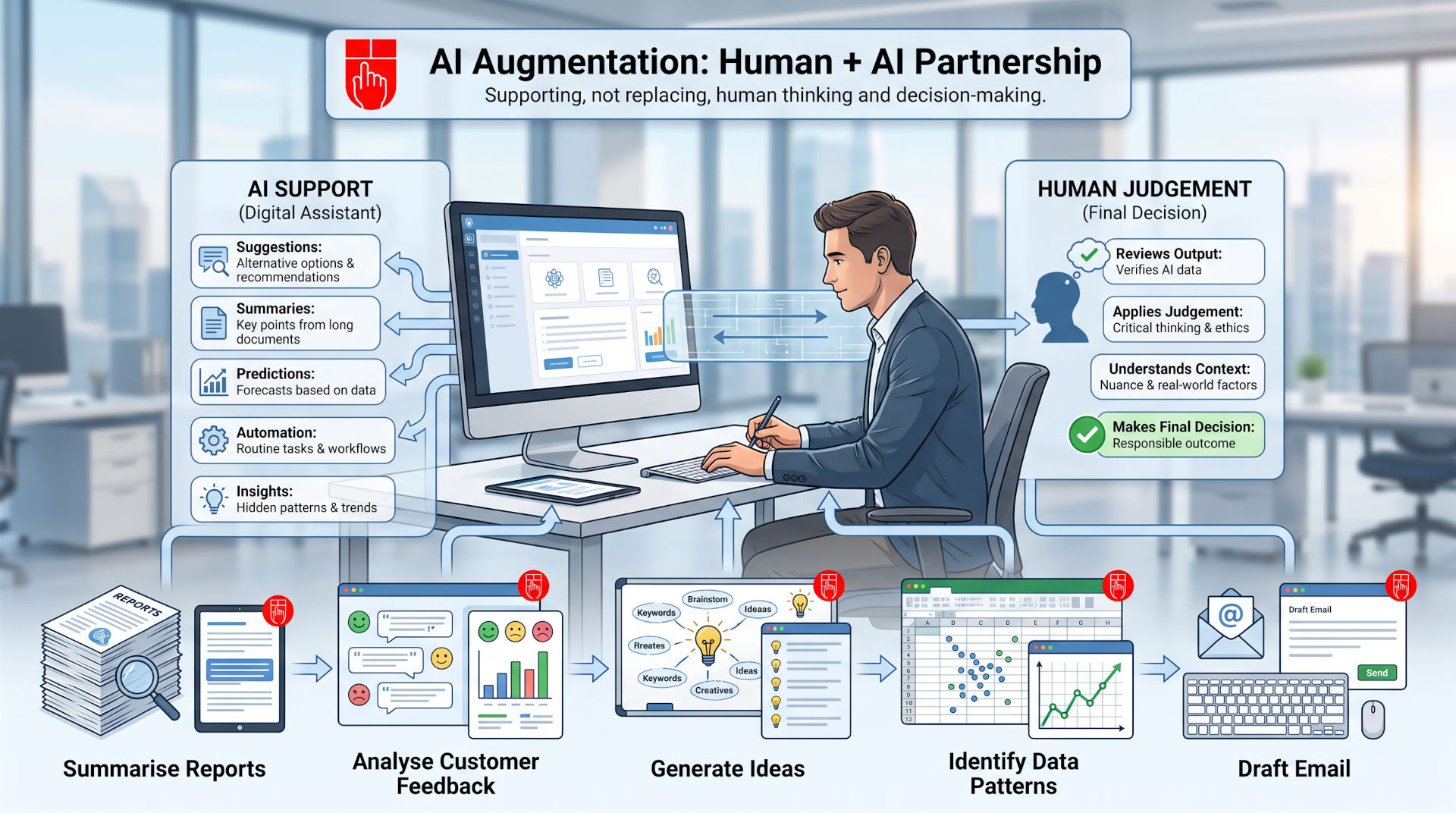
AI Should Support Human Decision-Making
One of the most powerful benefits of AI is its ability to ingest and process information at speeds impossible for the human brain. In business, AI supports decision-making by flagging risks, forecasting trends, and mapping out possible scenarios based on historical data.
However, AI processes the "what" and "how many," while humans provide the "why" and "what next." AI lacks lived experience, ethical grounding, emotional intelligence, and an understanding of real-world nuance. These deeply human qualities remain essential when making complex decisions that impact customers, employees, students, or long-term business integrity.
Examples of AI as an Augmented Tool
When deployed effectively, AI transforms workflows across virtually every sector by pairing machine speed with human insight:
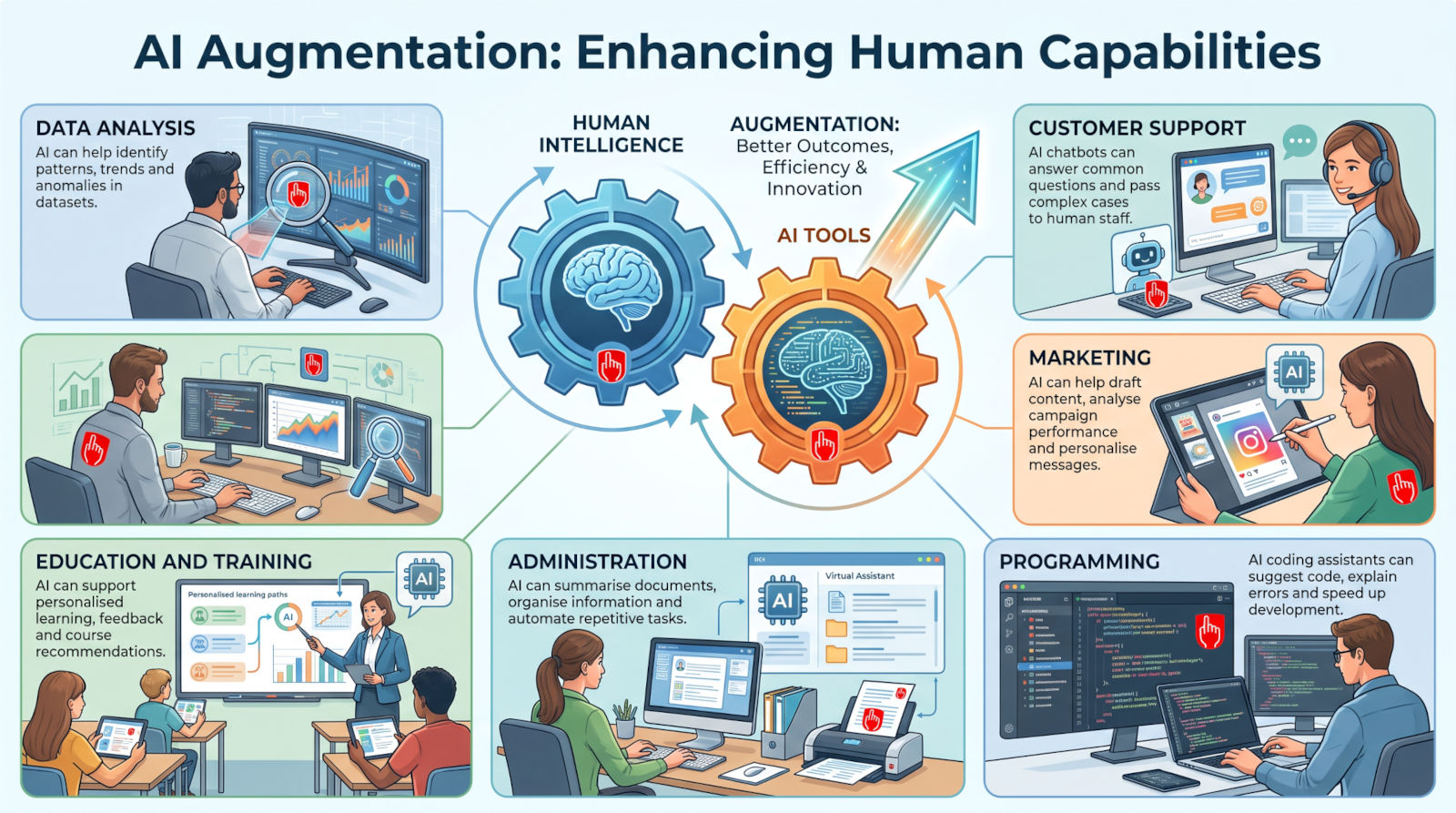
- Data Analysis: AI highlights anomalies and trends in massive datasets; the human analyst determines if it represents a critical business risk or a new market opportunity.
- Customer Support: AI chatbots instantly resolve common, repetitive queries, seamlessly routing complex, sensitive, or emotionally charged cases to empathetic human agents.
- Marketing & Content: AI helps overcome the "blank page" syndrome by drafting outlines and generating A/B test variations, while human creators inject brand voice, humour, and cultural relevance.
- Education & Training: AI provides personalised quizzes and learning pathways, allowing human educators to focus on 1-on-1 mentoring and addressing deep learning gaps.
- Software Development: AI coding assistants suggest boilerplate code and spot syntax errors in real-time, freeing human developers to focus on higher-level system architecture and user experience.
Why AI Does Not Remove the Need for Human Skills
Despite their power, modern AI tools are highly dependent on human direction. An AI model is a brilliant synthesiser but a terrible critical thinker. A person must ask the right questions, verify the output's accuracy, recognise the tool's blind spots, and decide how to apply the generated material in the real world.
Because of this, human "soft skills" are becoming more valuable, not less. Workers must cultivate digital confidence, critical thinking, adaptability, and clear communication. The most successful professionals of the next decade will be those who seamlessly blend their domain expertise with AI fluency.
The Importance of Human-in-the-Loop AI
Human-in-the-loop (HITL) means that people remain actively involved in reviewing, guiding, and approving AI outputs before they are finalised. This is critical because AI models can "hallucinate" facts, perpetuate historical biases found in their training data, or fail to grasp complex situational context.
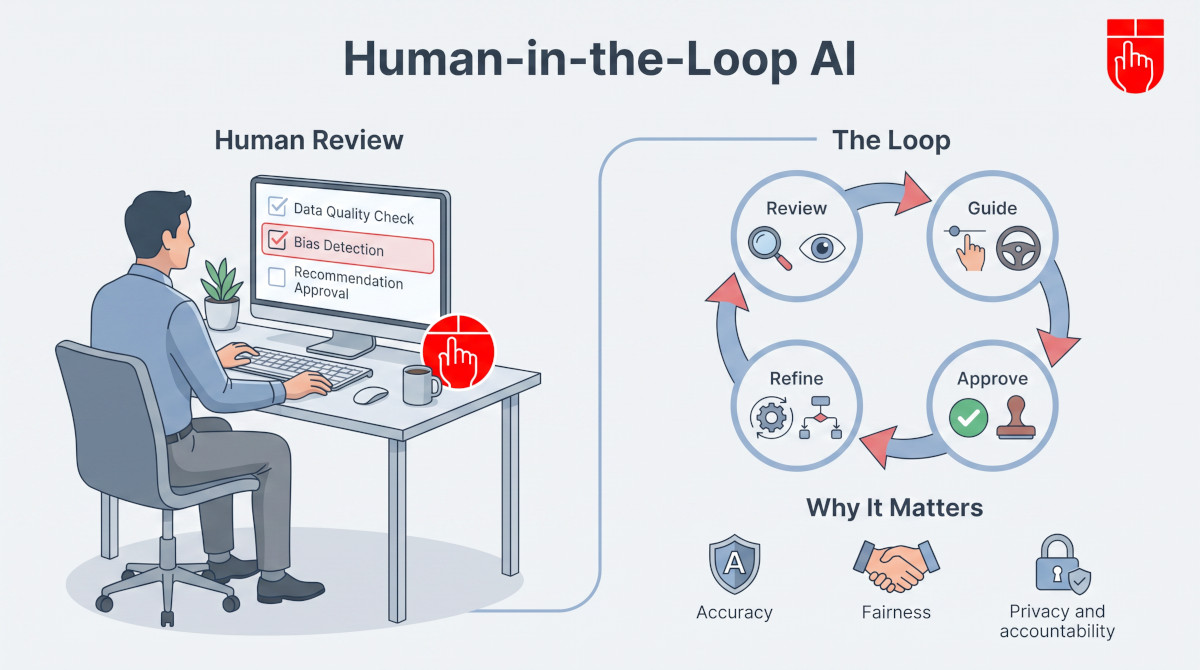
Whether an AI is suggesting a medical diagnosis, drafting a legal contract, or filtering job applicants, a human professional must review the recommendation before action is taken. This safeguard ensures that technology remains accountable, ethical, and accurate.
AI Can Help Workers Become More Productive
By automating repetitive routines, AI allows workers to reclaim their time and shift into a "flow state" focused on high-level analysis, strategic planning, and creative problem-solving.
A data scientist can use AI to instantly clean messy datasets, cutting hours of tedious formatting. A small business owner can use AI to quickly draft responses to routine customer inquiries. In every scenario, AI acts as a digital assistant that removes friction, allowing the worker to operate at the peak of their specific skillset.
New Skills Needed in the Age of AI
Thriving in an AI-augmented workplace requires more than just knowing how to log into a chatbot. Professionals need to develop a specific set of modern competencies:
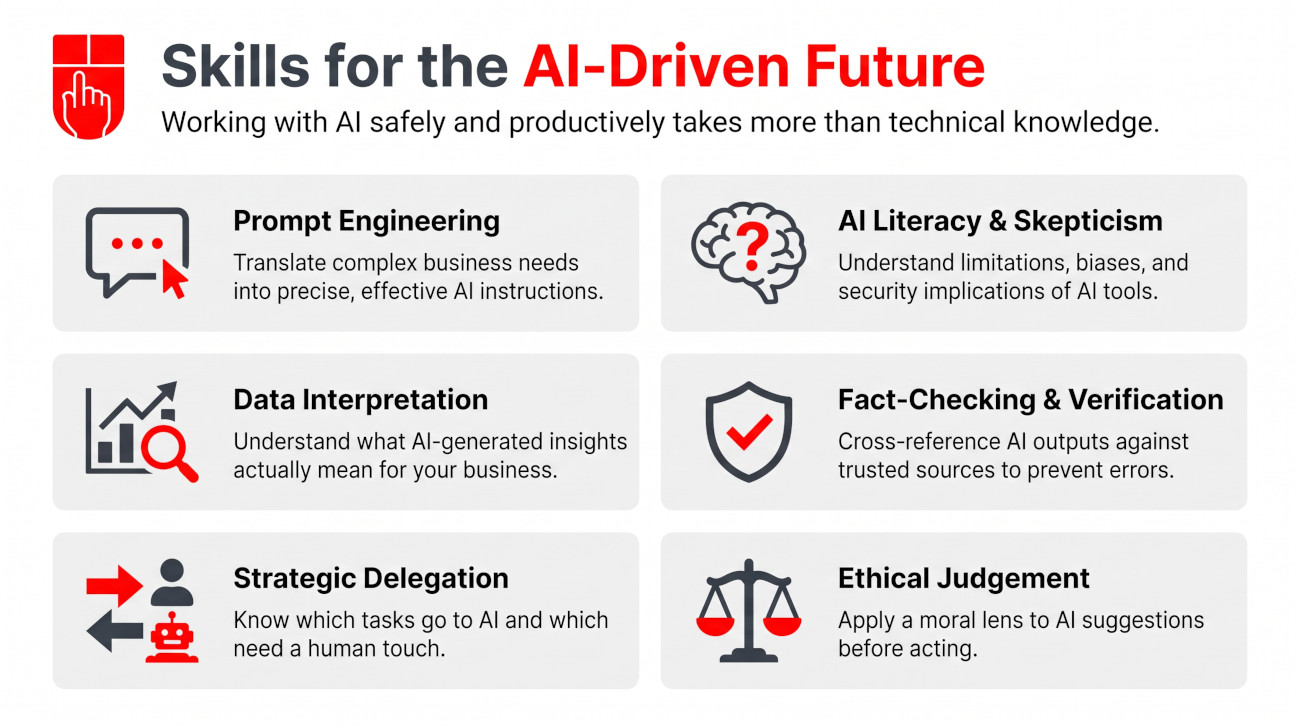
- Prompt Engineering: The ability to translate complex business needs into precise, effective instructions for AI models.
- AI Literacy & Scepticism: Understanding the limitations, potential biases, and security implications of the tools you use.
- Data Interpretation: Moving beyond gathering data to understanding what AI-generated insights actually mean for your business.
- Fact-Checking & Verification: Rapidly cross-referencing AI outputs against trusted sources to prevent errors.
- Strategic Delegation: Knowing exactly which tasks should be handed to AI and which require a human touch.
- Ethical Judgement: Applying a moral and ethical lens to AI suggestions before acting upon them.
AI and the Future of Work
The equation for the future is not Human vs. AI. It is Human + AI vs. Human without AI. While job roles will inevitably evolve and certain tasks will become fully automated, the demand for skilled workers who can wield these new tools will skyrocket.
Forward-thinking businesses that train their teams to use AI responsibly will see massive gains in innovation and efficiency. Similarly, individuals who proactively build their AI and data literacy will future-proof their careers and become invaluable assets in any industry.
Conclusion
Artificial Intelligence is not a replacement for human ingenuity; it is a catalyst for it. Its greatest value is realised when it operates alongside us, helping us make sharper decisions, execute tasks with unprecedented efficiency, and focus on the deeply human aspects of our work that machines cannot replicate.
The key to success is not to compete with technology, but to master it. Professionals who learn to merge their unique experience and creativity with AI capabilities will define the future of the workplace.
Are you ready to future-proof your career? At London Academy of IT, we offer practical, hands-on courses in Python, Data Analysis, Data Science, Machine Learning, AI, Generative AI, LLMs, and Agentic AI to help learners and professionals build the essential skills needed for the future of work. Explore our courses today and learn how to make AI work for you.