For decades, corporate decision-making relied upon siloed spreadsheets and fragmented manual reports. In 2026, the sheer scale and complexity of information have rendered these antiquated methods a significant operational bottleneck. To remain competitive in a digital economy, organisations require a structured framework for managing their information assets.
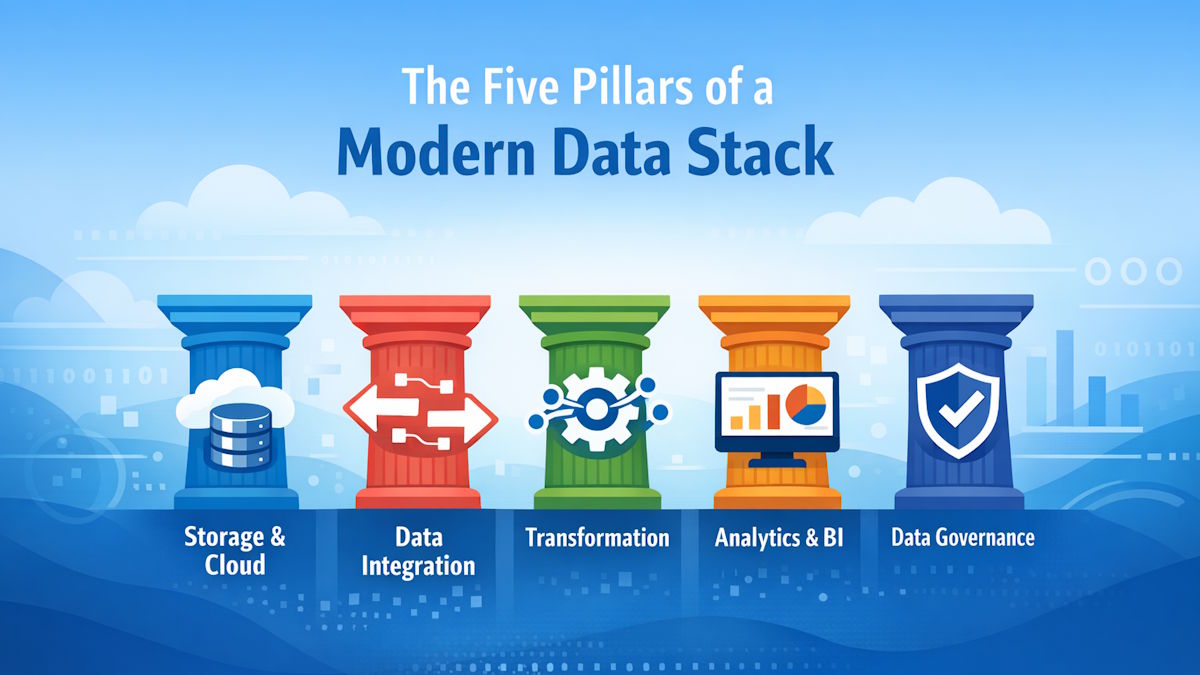
This framework is widely known as the Modern Data Stack. It is a cohesive assembly of cloud-based tools designed to transform raw, fragmented information into actionable business intelligence. Below are the five foundational pillars of a successful modern data architecture.
Pillar 1: Data Storage and the Cloud Warehouse
The anchor of the entire system is the cloud-native data warehouse or data lake. This is not merely storage in the traditional sense. It is a dynamic, elastic repository that separates computing power from storage capacity. This allows an organisation to process massive datasets without the constraints imposed by physical servers.
Prominent examples include Snowflake, Google BigQuery, and Amazon Redshift. By serving as a centralised hub, this pillar effectively breaks down data siloes and provides a unified view of the entire business operation.
Pillar 2: Data Integration and ingestion
Raw data remains inert until it is unified. Integration tools move information from disparate operational sources, such as a customer CRM, an advertising platform, or an internal product database, into the central warehouse.
Modern architecture has shifted from the traditional ETL (Extract, Transform, Load) model to a more efficient ELT approach. In this model, raw data is loaded into the warehouse first and transformed later. Platforms such as Fivetran or Airbyte automate this loading process, which significantly reduces the technical burden on IT teams and ensures that data flow remains reliable.
Pillar 3: Transformation and Modelling
Once loaded, data is often unorganised and unstructured. Transformation tools serve as the crucial link that processes this raw information, cleans it, and applies specific business logic to create structured data models.
This is the stage where SQL and Python become essential assets for a team. Leading transformation tools, such as dbt (data build tool), allow analysts to write transformation logic using standard SQL code. This turns data processing into an engineered, version-controlled, and testable workflow.
Pillar 4: Business Intelligence and Visualisation
This is the interface layer that most business users interact with on a daily basis. Modern visualisation tools go far beyond simple charts. They are interactive platforms that allow decision-makers to query their own data in real time.
Software such as Microsoft Power BI, Tableau, or Looker translates structured data models into dynamic dashboards. When the transformation layer is optimised, these tools can query the warehouse instantly to provide on-demand metrics regarding supply chains, financial forecasts, or customer acquisition costs.
Pillar 5: Governance and Data Trust
A data stack is only as valuable as the trust users place in its output. The final pillar focuses on data quality, lineage, and security, including strict adherence to GDPR requirements.
Data observability tools proactively monitor the stack to catch "data breakages," such as an API going offline or a source changing its format, before incorrect metrics reach a stakeholder’s dashboard. This pillar ensures that the system is not only fast but remains accurate and accountable at all times.
Conclusion
The modern data stack is designed for flexibility and operational agility. It transitions information from a passive, historical record into an active strategic driver. By focusing on these five pillars, corporate leaders can ensure their organisation is not merely storing data but is actively using it to gain a definitive competitive advantage.